

Policy Support and Domestic Leadership: Current Development Status of the Rotary Drilling Rig Industry
Release time: 2026-05-18
The combination of infrastructure support and the “dual carbon” policy has led to a steady growth period for the rotary drilling rig industry. Domestic enterprises have broken through technological barriers, and their market share continues to rise, forming a new pattern of favorable policies, technological autonomy, and global expansion.
Policy dividends continue to be released, laying a solid foundation for industry growth
At the national level, there is a continuous increase in infrastructure investment, with intensive implementation of projects such as the 14th Five Year Plan, urban renewal, underground space development, and new energy infrastructure, providing stable demand support for rotary drilling rigs. The “dual carbon” goal promotes the transformation of green construction, and electric and intelligent models are given policy support to accelerate the replacement of traditional high energy consuming معدات. In addition, the deepening of the “the Belt and Road” initiative has driven the demand for infrastructure construction along the line, created a favorable environment for domestic equipment to go to sea, and policies have worked together to promote the industry into high-quality development channels.
Domestic technology breakthrough leads the way, breaking the overseas monopoly pattern
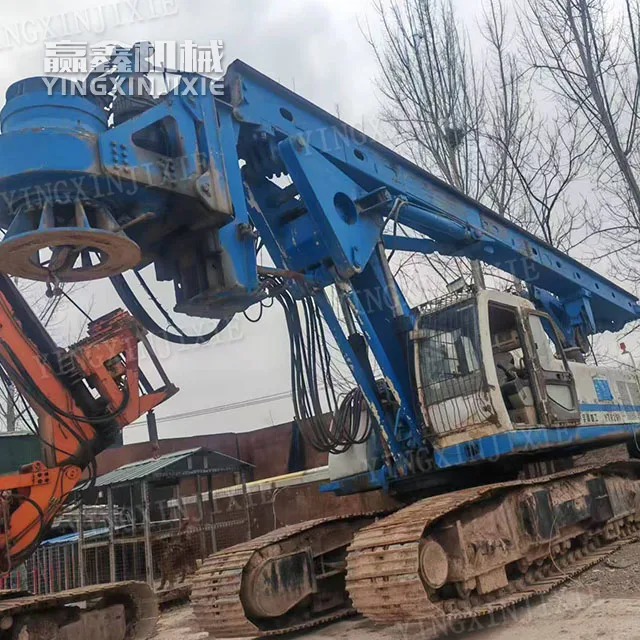
Domestic rotary drilling rigs have achieved a leap from following to leading, with top companies such as XCMG, Sany, and Zoomlion dominating the market, and the CR5 market share exceeds 70%. In terms of core technology, the localization rate of key components such as high torque power head, high-pressure hydraulic system, and intelligent control exceeds 65%, and the ability to perform hard rock construction and deep pile drilling has reached the international advanced level. In the field of electrification, extended range and pure electric منصات الحفر الدورانية are commercially available in bulk, balancing environmental protection and endurance, and suitable for green construction scenarios. Domestic equipment, with its high cost-effectiveness, strong adaptability to working conditions, and comprehensive services, has fully replaced imports and become the absolute mainstay of the market.
Optimizing market demand structure and driving growth through emerging scenarios
The demand for traditional housing construction is stabilizing, and new energy infrastructure, urban rail transit, and cross sea bridges have become core incremental markets. Projects such as offshore wind power pile foundations and pumped storage power stations are driving demand for large tonnage and high rock penetration capacity aircraft. At the same time, in scenarios such as municipal engineering and renovation of old residential areas, there is a preference for small and medium-sized, highly flexible معدات, and the market presents differentiated demand characteristics of “large-scale tackling, small-scale flexibility”. The upgrading of demand structure forces product iteration, driving the industry towards high-end and customized development.
The pace of going global is accelerating, and global competitiveness continues to improve
Domestic rotary drilling rigs have steadily increased their market share globally due to their mature technology, high cost-effectiveness, and strong adaptability. Southeast Asia, the Middle East, Africa, and other regions have become key export markets. The Middle East infrastructure boom, represented by the United Arab Emirates and Saudi Arabia, has driven the mass entry of domestic equipment, resulting in a surge in export orders for large pile foundation equipment such as rotary drilling rigs and pile drivers. Top enterprises have further consolidated their global competitiveness by establishing overseas factories and building localized service networks. Domestic rotary drilling rigs have become the benchmark category for Chinese construction machinery going global.